A Catholic Parent Takes on the Challenges of Parenting

Every day, the cross, with joy!
Showing posts with label penance. Show all posts

Thursday, March 7, 2019

Don't Let the Best (or Worst) Get the Best of You This Lent

As parents, Lent can be really tough. First, there's trying to fast on Ash Wednesday. As my daughter said to me, "Wait, that means you'll be fasting...and yelling at us!" It is hard to fast when you are simultaneously taking care of little people. At least when one is surrounded by adults, there is a standard of behavior that can win out even when one is feeling hangry.

Another thought that makes Lent tough on parents is the memory of past Lenten resolutions. It was somehow easier to take on those heroic Lenten penances when it was just you, spending your time how you wanted, choosing to go where you wanted, when you wanted, and to eat whatever you wanted, when you wanted. Now as parents, there are so many restrictions on us. The fact that I haven't set a morning alarm in 13 years is one indication of that. As if I ever decide when I'm going to wake up for the day!

If we aim to choose the "best" Lenten resolution by basing it on what our childless friends are doing, or based on what we've done in the past, we may be setting ourselves up for failure. It is preferable to choose the "better," more practical Lenten sacrifice than to choose the "best," which may prove impossible. We don't want our mortifications to mortify those around us, especially our children. It's ok, and even good, for them to see us struggle with abstaining from things we'd like to eat, or directing money from minor indulgences toward the poor, or sticking to our prayer commitments even when tired. But it's not ideal to fast every day, and then yell at them because we can't really handle it.

Life is already hard, every day, for parents trying to do their best. There are abundant mortifications, unchosen penances that fill our day. Because of that, we may also feel like Lent is a year-round season for us! It's fantastic if we can use those daily sufferings as penance, offering them up as mortifications that help us die to our own selfish desires.

My first child was due on Easter Monday, so those final days of my pregnancy coincided with Lent. I remember glaring at my husband when he asked what I was "giving up" for Lent. "Let's see, I've given up my physical comfort, my sleep, my normal eating," blah, blah, blah. I included all the expected gripes of a woman in the final trimester of pregnancy. Sometimes, as then, life feels hard enough to make Lent seem like an unnecessary add-on.

Does parenting often feel challenging? Do these struggles appear to have no end in sight? Don't parents already have far more mortifications than the average person? Absolutely, yes. It is normal and fine to recognize the difficulties inherent in trying to be a good parent. It's true that our parenting is more often criticized than appreciated.

And yet, we shouldn't let the worst of parenting life prevent us from making Lent feel different to us. There should be some way we can make this season of voluntary preparation and penance feel different. If we can accept that we can't do the "best" penance, we should accept that we shouldn't do the "worst" penance, that is, no particular voluntary penance at all.

Instead, we may be able to incorporate the involuntary mortifications into our Lenten practices. For example, if a teething baby has us awake at night, how about saying one station of the cross every time we are awakened? If we have to take kids to extra medical or dental appointments, why not say the Rosary while we drive? If our pantry is in need of cleaning, why not try the challenge of minimizing food shopping while working through all the food in the pantry during the season of Lent? If we recognize our phone as a distraction, why not put it on grayscale for Lent?

Sometimes Lent seems to amp up the pressure on an already stressed parent, but it doesn't have to be that way. There can be openings to God's grace, whether we do the best, most heroic penance or even if we do the worst (none at all) penance. But if we are willing to forego the best and avoid the worst, making some effort to observe the season of Lent, we invite that grace into our personal lives and, what's even better, into our Catholic homes.


Monday, December 4, 2017

Advent Opportunity


It’s that time of the year again, where friends, family, and stores are full-swing in the Christmas spirit. There is much to celebrate about an increasingly secular culture where people nonetheless throw themselves into a holiday that is centered around the birth of Jesus Christ. This time of the year provides more material reminders of the holiday than any other, from songs to trees to lights to to cookies to nativity sets. Even those who do not honor the “reason for the season” seem to be a little kinder, a little more generous, and a little more cheerful in the weeks leading up to Christmas.

Given this, it can seem particularly ironic when faithful Catholics try to direct focus back to the penitential and preparatory season of Advent. Instead of focusing on the thorn – the loss of Advent in our culture – why not simply acknowledge the rose, which is the increasing attention given to Christmas?

Looking at this as a simple either/or dilemma, however, does not really provide a solution in terms of the practicality of how Catholics choose to live in those weeks leading up to Christmas. We lose out on something if we disdain those who put their trees up on Thanksgiving and refuse to attend Christmas parties that happen during Advent. In particular, we may give the impression that we are “anti-Christmas.” But we also lose out on something if we ignore the liturgical messages given to us during Mass throughout the season of Advent and instead act as though the Christmas season precedes Christmas day. Specifically, in losing the preparation, we may also lose the celebration.

There are ways, however, to join in the joy and cheerfulness that we see around us while also practicing the preparation and reflection characteristic to the season of Advent. Advent has long been considered “the little Lent.” Like Lent, Advent is characterized by the color purple. It is a color that denotes preparation, but, more importantly, the color denotes penitence. Historically, the Catholic Church at times practiced daily fasting and abstinence from meat throughout the season of Advent. In some parts of the world, Wednesdays and Fridays continue to be days of abstinence from meat during the season of Advent. A century ago, American Catholics were encouraged, although not required, to take up Advent resolutions, much like today’s Lenten resolutions.

It may seem like an “Advent resolution” could throw a serious wrench in an attempt at joining in secular culture’s Christmas cheer. But that doesn’t have to be the case…in fact, penance has long been associated with supernatural joy. And with the effervescence of Christmas spirit surrounding us, it is possible to gain much by practicing a bit of penance in the midst of this season.

Just as Lenten resolutions center around the traditional triad of almsgiving, fasting, and prayer, so also for Advent resolutions.

The practice of almsgiving asks us to sacrifice our own desires and needs in order to give to others. In the season of Advent, we are surrounded with invitations to partake in this kind of giving. We can support national organizations, such as Catholic Relief Services, which does amazing charitable work around the globe. Local Catholic Charities also provide tremendous resources to the community. The parish food pantry or other parochial ministries are great opportunities for almsgiving as well. Many parishes have giving trees, sandwich-making drives, and the like that can become part of our Advent.

Beyond these established organizations and ministries, we might also use the season of Advent to pay more attention to others around us, rather than getting lost in our own plans. We are often unaware of the many needs of friends, family, and acquaintances who are right in our midst. Advent is a good time to write a letter to an elderly family member, take a meal to the mom of a new baby, or visit someone who is sick and homebound. For those of us with kids at home, this almsgiving of time may seem impractical or even impossible. But there are other opportunities as well. For example, Advent may be the time to save a parent a trip by offering to take his child to and from sports practice. With a little creativity and increased intention to the needs of those around us, we can find ample opportunity for almsgiving.

Fasting, as mentioned above, used to characterize the season of Advent, as it did Lent. Our Eastern brothers and sisters in the faith continue to practice a Philippian fast (beginning on November 15th after the feast of St. Philip) prior to the great feast of Christmas. Most of us Catholics are quite out of the habit of fasting, but, nonetheless, there are some smaller “fasts” we can make in the weeks prior to Christmas.

Some suggestions include giving up sweets, alcohol, meat, or snacks between meals. While reminding us that we are still preparing for Christmas, abstaining from such foods during Advent can help accentuate the joy and celebration on Christmas day and throughout the Christmas season. For those that dread the long season of Lent, note that the season of Advent is much shorter than Lent! Of course, we may find ourselves in situations, such as Christmas parties, where we are expected to partake of celebratory food and drink. One way of addressing this is to select the cookie we least desire or limit ourselves to only one drink.

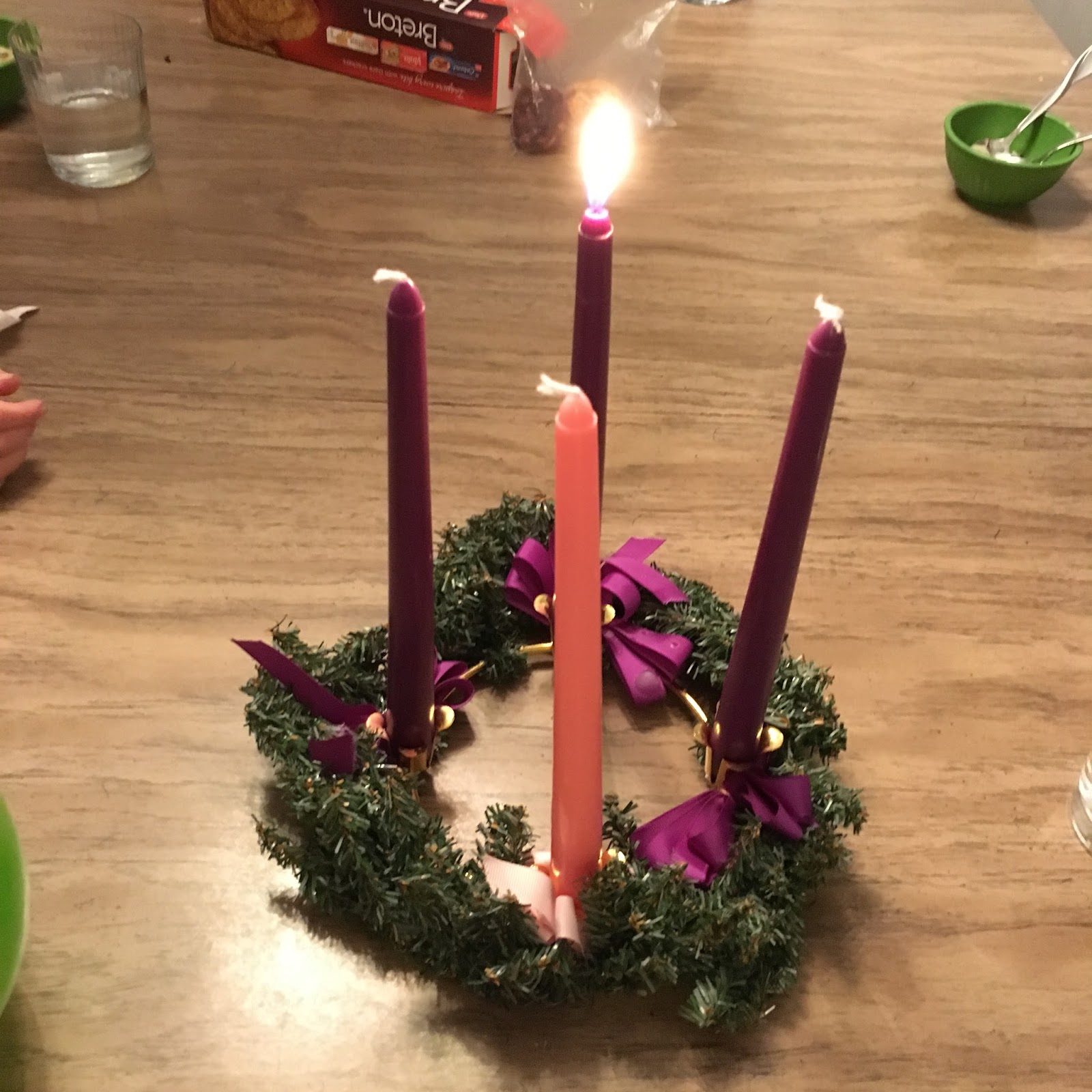
Like Lent, Advent is a great time to renew our prayer life. In particular, during Advent we might spend time reflecting on the coming of Christ: in his birth in Bethlehem, at the end of time, and in the Eucharist. The daily Mass readings for the season of Advent are rich in meaning. The “O antiphons,” featured in the traditional song “O come, O come, Emmanuel,” also inspire a sense of desire and anticipation for Christmas. The nightly lighting of an Advent wreath, marking the weeks with the three purple and one pink candle remind us that we are still waiting for Christmas. Those who pray the Rosary regularly may benefit by focusing upon the joyous mysteries during Advent.

There are times where we may feel overwhelmed by shopping and wrapping, cleaning and cooking. But these acts, too, can be occasions for prayer if we choose to make them so.

Finally, one of the best ways to prepare our hearts for the celebration of Christmas is to partake in the sacrament of Confession. The penitential acts of identifying and confessing our sins may be the most important preparation for Christmas, and the grace received during absolution will surely be one of the best Christmas gifts we get. During the weeks leading up to Christmas, there is much that we have to do, but in the end, we have to remember that we aren’t ultimately responsible for Christmas happening. It is a gift that we can receive, better or worse, depending upon our preparation.

So, as Advent begins and continues alongside the already happening Christmas celebrations, let us do our best to live Advent well. Such a commemoration of this season will not only prepare us for Christmas day, but also contribute to the joy we see around us.


Sunday, November 27, 2016

Easy Advent


The "holiday season," as it's conventionally known, is supposed to be a great time of fun events and joyful traditions. Yet, for many parents of young children, it can feel very stressful. Details like figuring out gifts for the kids (and not going overboard, plus not going broke) and gifts for extended family, deciding about (and preparing for) travel to visit (or host) family, etc. The holiday season is a time when we just want to do it all! There is so much that is unique, fun, and seemingly essential for giving kids the joy of this time of the year.

Of course, for Catholics, this time of the year is actually the season of Advent, a penitential and preparatory season for the celebration of Christmas. In our culture today, it would be pretty difficult to disentangle oneself (and one's family) entirely from the delights of Christmas during the season of Advent. Nor do we who love the birth of Jesus want to be perceived as grinches during the weeks prior to Christmas Day.

So here are some ideas for having an "Easy Advent" with young kids that can also be spiritually fulfilling as preparation and not too stressful. Pick and choose...don't feel you have to do them all!


1. The Advent wreath. This traditional Catholic practice is a family favorite, which is easy to incorporate into daily life. Simply light the candle(s) before dinner while singing a verse of "O Come, O Come, Emmanuel" or some such Advent song.

2. All those Christmas cards. We want to pray for our friends and family, but it can be easy to forget these intentions in the midst of holiday busy-ness. Let the cards you receive in the mail be an opportunity. Set aside the day's cards by your Advent wreath, and prior to lighting the candles in the evening, open those cards to show to the kids, and then offer a prayer for these family and friends before you sing.

3. Christmas books. We are blessed - truly blessed - with the material culture surrounding Christmas. It's really the only time of the year with such a multitude of books, songs, and images of Jesus, Mary, and Joseph. With extra demands, it may be challenging to accommodate the kind of Advent spiritual reading you'd personally like to do, but there are many beautiful Christmas books that can help to prepare your heart (as well as your children's) during the season of Advent. Here's a link to some of my favorite books.

4. Nativity set. It's great if you can have a nativity set available for your children to interact with. The Little People set has been with us for the last ten years. Playmobil also has a set available, and there are many other such sets. Children can play with these on their own (obviously), but it also can be nice to "act out" the story for them with the figures.

5. Sing! There are many wonderful Advent hymns, as well as Christmas songs that can be appropriate during Advent as they help the kids to understand and appreciate the meaning of Christmas. As St. Augustine said, when you sing, you pray twice...so definitely sing!

6. Advent calendars. I hear a lot of complaints from moms who are sick of the Elf on the Shelf and having to make that happen for their kids in the weeks before Christmas, which are already so stressful. Advent calendars are a much easier (and more traditional) way to count down the days. You can buy an empty one and just fill with a piece of chocolate (or something else that's simple) for each day, or it's also possible to find inexpensive pre-filled chocolate Advent calendars.

7. Incremental decorations. Most of us LOVE Christmas decorations. And it can be hard to wait until Christmas eve (as Catholics used to do) to put up the tree, garlands, etc. So one idea is to try to put up decorations incrementally, perhaps on the Sundays of Advent...and try to save the tree for Gaudete Sunday (the third Sunday) or the fourth Sunday of Advent. It can be helpful to save at least SOME decorations for Christmas Eve so the house looks different on Christmas day.

8. Celebrate the feasts! The month of December brings us St. Nicholas (December 6), Our Lady of the Immaculate Conception (December 8), Our Lady of Guadalupe (December 12), and St. Lucia (December 13), among others. Coming from a German background, I find it natural to celebrate St. Nicholas' feast by having my kids leave out their shoes. Candy canes and chocolate coins are not just treats, but opportunities to talk about St. Nick the Catholic bishop who stood for the truth of the faith and also acted generously to help those who were poor. Our family tradition on this day has also been the gifting of matching Christmas pajamas, which the kids love. At times, I've also given them a Christmas/Catholic book on this day: something I'd like them to have, which I know they won't be excited by in the midst of more exciting presents on Christmas day. December 8 is a Solemnity, as we celebrate the patronal feast of the U.S., the Immaculate Conception. So this is a great night for a special dessert or some other celebration. Tomie de Paola's book "Our Lady of Guadalupe" is a great way to teach kids about the December 12 feast. It's also a good day to have some Mexican food or pan dulce. St. Lucia, patroness of light, is a good day to hang up some Christmas lights!

9. Jesus stocking. A cartoon written for a children's magazine in the 1950s showed students making an effort to do something special for Jesus during Advent as a "birthday gift" for Jesus. I recently learned of a way to make this concrete for young children by hanging up a Jesus stocking during Advent. When children do something good for Jesus (putting away their shoes, giving a brother a toy he wants, participating in the family Rosary, eating dinner without complaining, etc.), they can put this present in Jesus' stocking. You can either just write the gift on paper and put it in, or get little tokens or presents to represent those gifts. The idea is for Jesus to have lots of "gifts" by his birthday.

10. Penance and being choosy. Advent is a great time to take on an Advent resolution, akin to the Lenten resolution you might normally make during Lent. Advent is much shorter, so it's not quite the same type of Lenten marathon, but it can assist mindfulness of the preparation for Christmas. A family sacrifice (meat, sweets) can also be great...but don't make your kids hate Advent by making it austere and abstemious while the rest of the US is celebrating! Also, offer some of the stresses (gift-giving, baking, etc.) as penance, mortifications that are a dying to self in that it might not be how we'd choose to spend Advent. It's easy to get overwhelmed at this time of year: pray, offer it to God, grow in dependence upon God when you realize you have too much to do. Say no when necessary, and don't think you have to do EVERYTHING. Lastly, Advent is an excellent time to seek the sacrament of confession. What better way to prepare for Christmas, than by encountering God's forgiveness and mercy!

(For my previous thoughts on Advent, click here and here.)


Tuesday, February 17, 2015

Family-based Lenten Resolutions

Coming up with a good Lenten penance is often challenging for faithful Catholics, including busy parents. We might have high ambitions, but choosing and sticking with a Lenten sacrifice can be difficult. In part, this difficulty stems from the individual nature of Lenten penance as currently practiced. Prior to the Lent of 1967 all Catholics in the U.S. abided by the same Lenten practice of fasting every day of Lent (excluding solemnities, such as Sundays). This provided built-in social support. Lenten resolutions are not meant to be tests of individual willpower demonstrating heroic self-control. A Lenten resolution should be part of the shared endeavor to embrace penance as a preparation for Easter. 

It's not about YOU, but about US, the Church.

Though the Church no longer has the strict Lenten observance that provided unity in penance, the family provides a setting that makes possible the practice of social penance - a penance that is not simply about individual voluntary mortifications, though those are also good! By deciding on and practicing a Lenten penance as parents (or as a family, if you're children are older), parents can promote the idea that penance is not about YOU, but about US and OUR relationship to God. Here are a few suggestions for family-based Lenten resolutions:

FOOD:
Food-based resolutions can be good ideas to implement as a family.
1. Abstaining from meat during Lent (excluding solemnities). This is a traditional Lenten penance still observed in many places.
2. Abstaining from eggs and dairy during Lent. This is another traditional Lenten penance.
3. Abstaining from dining out or ordering in food. This penance might also provide some extra change that can be used in almsgiving.
4. Abstaining from processed foods such as boxed cereal, and replacing it with non-processed or minimally-processed food such as oatmeal.
5. Empty the pantry. Commit yourself to using up as much food in your pantry as possible while simultaneously limiting the food you purchase in your regular food shopping trip. Again, this should provide extra change that can be used in almsgiving.
6. Abstaining from sweets.
7. Giving up certain beverages, such as soda or alcohol, or limiting intake. Possibly even abstaining from all beverages excepting water or milk (and coffee for adults who need it!). 

ENTERTAINMENT/TECHNOLOGY:
Entertainment resolutions can also present possibilities for family-based Lenten resolutions.
1. Abstaining from or limiting time on the Internet, television, games, movies, etc.
2. Consider using the time normally devoted to entertainment/technology for activities like writing letters to people.
3. Not listening to music while in the car.

ALMSGIVING:
The above practices should decrease spending and make possible additional almsgiving. Contributing to the usual Rice Bowl donation box is a good way to indicate to the whole family the monetary result of the above sacrifices.

PRAYER:
Choosing a family prayer practice to add into the regular schedule can also be a great family-based Lenten resolution.
1. Such practices might include praying the Rosary, the Chaplet of Divine Mercy, attending Eucharistic adoration together, attending daily Mass, reading aloud the daily Mass readings at dinnertime, and praying the Stations of the Cross. For young children, presenting one Station of the Cross per evening and saying an Our Father, Hail Mary, and Glory Be before dinner might be the most you can do.
2. A variation of this is to invite friends or family over to pray the Stations of the Cross, followed by a simple meal.
3. (With older kids) As a family, commit to a more regular reception of the sacrament of confession throughout the season of Lent.

WORKS OF MERCY:
Depending on the age of your children, you might want to consider the possibility of donating your time as a family to a charity, e.g. volunteering in a soup kitchen. There are other ways to engage directly in the corporal and spiritual works of mercy; be creative. You may be able to take a meal to a family mourning someone's death or to visit a homebound elderly friend, for example.

SPRING CLEANING:
"Spring cleaning" can certainly be a mortification, and Lent also presents itself as an ideal time to have family members clean out their rooms, go through their clothes and their toys, and donate or get rid of items they are no longer using. Lent is a good time to take on home-organization tasks that might involve the family. This cleaning can also be a helpful metaphor for the preparation undertaken for Easter.

FINAL CONSIDERATIONS:
1. There are many other possibilities for family-based mortifications, such as lowering the temperature of your water heater or thermostat.
2. Make sure that you and your spouse agree and have a plan for implementing the Lenten penance.
3. Try to avoid choosing anything that will make life particularly difficult for one particular person in the family.
4. Be willing to reevaluate each Sunday if necessary; don't let the sacrifices make your kids hate Lent. It might be best to change the resolution.
5. Consider the possibility of adding another penance each Monday.
6. Consider taking on your own individual Lenten resolution in addition to the family sacrifice.
7. Remember that your modeling of Lenten penance is crucial. It's ok to admit it's challenging, but complaining or being nasty to your family is not a good witness to the penitential power of Lent. If you recognize that you are consistently failing, reevaluate and choose a different penance.


Tuesday, December 2, 2014

On Advent, a Penitential Season


It's that time of year again...when Catholics begin a new liturgical year with the season of Advent. With this in mind, I wanted to summarize a few basic characteristics of the wonderful liturgical season of Advent, which is so often misunderstood by Catholics today, especially living in the midst of a culture that begins Christmas celebrations seemingly immediately following Thanksgiving.

Parenting mortification is about being willing to accept challenges and difficulties and to offer them to God as an opportunity to die to one's self and live more fully for God. One great asset to parenting mortification is the embrace of voluntary mortifications in addition to the involuntary mortifications of parenthood. Advent is a great season to take on a voluntary mortification (akin to the Lenten resolution). It's also a great time to teach your kids (and yourselves!) about the virtue of patience. The waiting is the hardest part.

1. Advent is penitential in nature. The purple vestments worn by the priest during the season of Advent should be indication enough of the penitential nature of Advent. Since Vatican II, however, some parishes have chosen to embrace blue vestments in order visually to distinguish Advent from the season of Lent. Blue is not an officially acceptable liturgical color for the season of Advent in the Roman rite, however. The violet color of Advent in fact is meant to associate Advent with Lent. Advent was traditionally called "the little Lent" and the penance of Advent, like the penance of Lent, was meant to prepare the faithful for a great celebration. The other penitential liturgical changes for the season of Advent include the omission of the Gloria at the Mass and the omission of the Te Deum from the Divine Office.

2. There are traditional communal penances of Advent. The customary Advent in such places as Rome included a Catholic fast (including meat abstinence) on Wednesdays and Fridays throughout Advent. The difficulties of immigrant life in the U.S. led the Third Provincial Council of Baltimore to request a dispensation from this Advent fasting, as well as a dispensation from Wednesday meat abstinence. The request was granted, and the U.S. has never since been obligated to Wednesday-Friday Advent fasting. Eastern Catholics, like the Orthodox, customarily practiced a strict 40-day "Philippian fast" during the season of Advent (the Orthodox feast of St. Philip is celebrated on November 14th, and the fast follows that feast).

3. Advent is a time for preparation. Too often today we associate penance with difficulty and gloominess. Undoubtedly penance does involve some degree of difficulty; the word mortification does come from the word for "death," after all. But the point of Advent penance or Lenten penance or Friday penance is similar in that it is a preparation. Penances - even small penances with minimum difficulty - serve as a constant reminder that something is going on. Penance turns our mind to preparation and helps prepare us to celebrate big feasts, like Christmas or Easter or Sunday, well. Given the demands of Christmas in terms of gift-giving, cooking, etc., Advent concretely lends itself to recognition as a season of preparation. But on the other hand, the demands of these material preparations can distract us from spiritual preparation.

4. Advent is distinct from Christmas. This point really should be self-evident, but unfortunately in American culture today there is no real distinction between Advent and Christmas. Catholics who attend Mass only weekly will notice perhaps an Advent wreath and the purple vestments of the priest, but they will be immersed the rest of the week in "Secret Santas," office parties, Elf on the Shelf, major sales of retailers, ubiquitous Christmas decorations, and Christmas music. Even Advent calendars tend to be Christmas-themed, and some are now identified simply as "Countdown to Christmas" calendars. Liturgically, however, Advent and Christmas are distinct seasons. Up until Pope John XXIII, Catholics were required to fast on Christmas Eve in preparation for Christmas Day; the pope moved that fast to December 23rd, but like other vigil fasts, this Christmas Eve fast was dropped in 1966.

Practical implications: After these few basic characteristics of Advent, we might wonder how best to observe the season of Advent. Especially in the midst of a culture that is already celebrating Christmas, how might Catholics observe Advent faithfully without appearing judgmental or Scroogish to those already fully immersed in holiday celebration?

1. The Advent Wreath. Chief among the liturgical practices of Advent is the lighting of the Advent wreath, with three purple candles, and one pink. It is a great family tradition to light the Advent wreath each night before dinner.

2. Sing Advent Hymns. When you go out in public, you WILL hear Christmas music; that's pretty much a given. In your own space, however, you should sing Advent songs. There are so many beautiful Advent hymns that really speak to the longing and preparation of the season. It's a great idea to sing one of these songs when lighting the Advent wreath each night.

3. Voluntary Penance. Given that Advent is a penitential season, it is an excellent time to take up a voluntary penance. This can be done as a family, e.g. going vegetarian for the season of Advent. The penance can also be done individually, e.g. giving up sweets. Other ideas include increasing almsgiving, adding some special Advent prayers, or being more cheerful.

4. Preparation. All of the above facilitate preparation for Christmas. But there is more that can be done to prepare. Advent is a great time to attend daily Mass. If you are unable to do that, you might take five to ten minutes and at least read and reflect on the daily Mass readings for that day. This brings home the liturgical sense of Advent, including both the longing for Christ's final coming at the end of time and the longing for Christ's birth in Bethlehem.

5. The Sacrament of Confession. Given that Advent is a season for penance and preparation, it is a wonderful time to receive the sacrament of confession. Many churches have confession days or communal services during the season of Advent to facilitate people receiving this sacrament.

6. Dealing with Christmas during Advent. We love Christmas. And that's one reason why it is so hard to wait when the rest of America seems already to be celebrating. How should we handle Christmas parties that take place during Advent? And how do we make our material preparations, e.g. gift-buying, for Christmas without letting the materialism take possession of all our spare moments? These are some of the most difficult challenges to address. Sometimes it is simply impractical to refuse attending "Christmas" parties during Advent. And dealing with kids' enthusiasm for Christmas can make this even more difficult; we don't want to crush their Christmas spirit or make them feel left out when all their classmates have already begun with the Christmas excitement. Hence there is no perfect solution to these problems. Priests in the 1950s suggested avoiding lavish parties and practicing moderation and abstemiousness at other Christmas parties during Advent. Instead of taking the cookie you want, try the one you don't want. Instead of having two drinks, limit yourself to one.

6a. The Decoration Debate. Ideally, Catholics would not put up Christmas decorations until Christmas Eve, and they would leave them out until the Feast of the Baptism of the Lord, which ends the Christmas season. Sticking rigidly to this can be challenging, given the need for preparation, not to mention the excitement of the kiddos. Sometimes it can be helpful for both of these issues to choose one or two things to do ahead of time. Gaudete Sunday, the third Sunday of Advent, can be a good day for this. For example, my family has sometimes put up our tree on this day. Another idea is to wait until the "O antiphons" begin, marking the last seven days of Advent, and get out one decoration each day. If you can manage it for your particular situation, you might delay decorating altogether until Christmas Eve.

6b. The Nativity Set(s). My kids have their own little nativity set, and they all love to play with it. In the past, I've taken it out right at the beginning of Advent as a way of helping them prepare for Christmas. It almost always, happens, however, that by the time Christmas hits, they are tired of it. This coincides nicely with their receiving Christmas gifts, I suppose, but it also can be a bit disappointing to see them tired of the nativity story. So in recent years, I've delayed taking it out until Gaudete Sunday, or, even better, the beginning of the O antiphons on December 17. Of all the "Christmas" decorations, however, this one - with an empty crib until Christmas Eve, of course! - is the most appropriate for Advent.

6c. Prayerful Material Preparation. Pope Benedict XVI once noted the appropriateness of gift-giving that characterizes Christmas. God has given us the wonderful gift of Jesus; it is good for us also to be generous like God in our giving of gifts. And yet this can often become a stressful task. Planning ahead is important, and not overthinking gifts is also important. Like any worry, gift-giving and wrapping are a good thing to approach prayerfully, asking for God's guidance in selecting good gifts. Wrapping each gift is a nice time to say a prayer for the person who will receive the gift. Cooking and baking should ideally be done in this same spirit.

6d. The Advent Calendar. Advent calendars come in all varieties these days...although mostly with Christmas colors and themes. Nonetheless, they can serve as a very practical way for kids (and adults) to prepare for Christmas. My kids always love their chocolate-filled Advent calendars. I worry that they don't represent the penitential element of Advent, but we have a tradition of them saying "Maranatha! or Come, Lord Jesus," each morning before receiving their chocolate, and this is a good reminder, not to mention the discipline of only getting ONE piece of chocolate each day.

6e. Spiritual Reading for Kids. Through the years, we have acquired a large collection of Christmas books. There would be too many for us to appreciate them in the brief season of Christmas, so we generally get them out at the beginning of Advent. These are helpful in preparing them for Christmas, and I find that they actually help me think about the meaning of Christmas too!

7. Big Feasts During Advent. Don't forget that there are some great feasts that occur during the season of Advent. One of our favorites is St. Nicholas Day, December 6th. I find this to be a good day to sneak a little "Christmas" into Advent without undermining Advent. My kids put out their shoes and I fill them with candy canes and gold-wrapped chocolate coins. Sometimes they even get a book or a movie...or matching pajamas. We love St. Nicholas, and the candy canes and coins are a great opportunity to discuss his life as a bishop defending the truth and as a generous pastor concerned with the welfare of his congregation. The Solemnity of the Immaculate Conception on December 8th is another important feast to celebrate, and given that it is a solemnity, it should offer a brief reprieve from your voluntary penance. December 12th, the Feast of Our Lady of Guadalupe is a great time to recall the story of Juan Diego in Mexico and talk to your children about that feast. December 13th, the Feast of St. Lucy, is a good day to light candles and talk about Jesus as the light in the darkness.

8. Celebrate Christmas Well. By the time Christmas actually comes, most people are ready to be done with it. They put away their decorations on December 26th and leave Christmas behind for another year. That is not the Catholic way, however. Christmas continues, especially for the octave (the first eight days), but also for the "Twelve Days" of Christmas. Epiphany is within the Christmas season, which technically does not end until the Feast of the Baptism of the Lord. Keeping Christmas going can be just as challenging as was postponing it. A special dessert each day might help, listening to Christmas music, inviting over friends and visiting friends or people in need, or doing extra acts of kindness can help keep the Christmas spirit going. And of course, don't put those decorations away until Christmas is over.

Sunday, April 13, 2014

On Failure and the Sacrament of Confession


By now it's probably obvious that I think parenting mortification is a great idea. Suddenly even things that seem bad - from sleep deprivation to a sick kid - can be viewed more positively, as opportunities for dying to self and living for God. Ideally, we parents who have embraced the daily sacrifices of parenting in this way would deal gracefully with each challenge that besets us, seeing every difficulty as a blessing that allows us to look beyond natural inconvenience to supernatural significance.

In reality, even those who embrace parenting mortification (or write a blog about it!) can fail in trying to live it out. It's wonderful to have thought about how to embrace particular problems of parenting, as well as discerning false crosses, and striving to find prayer to sustain ourselves spiritually in the midst of parenting. But let's face it, we all fail to embrace our crosses (parenting-related or otherwise) at some point. Sometimes that failure is partly the result of difficult circumstances. But at other times that rejection of the cross is an embrace of the self, whether purposeful or caused by a lack of recollection, examination, and reflection.

There are times that we not only fail to bear cheerfully with our burdens, but in addition to losing that opportunity, we also sin by complaining bitterly about them, taking out our frustration by yelling angrily at our kids or spouse, and then staying up too late consoling ourselves with ice cream and a novel. At times this can even become a cycle, since staying up late can make us tired the next day and impatient and perhaps needy for affirmation, which doesn't always come on demand from our children. Like defiant little kids, we may recognize that we've done something wrong but respond to it indignantly, behaving even worse than before and making angry excuses for ourselves.

Of course, that doesn't solve the problem or ultimately make us feel any better about the sins we commit toward others, including our children. Like those defiant little kids, what we really want is forgiveness, a merciful embrace that affirms us and our efforts, eases our burdens, erases our sins, and gives us the strength to try again.

Such an aid is readily available to us in the sacrament of confession.

Here are a few ideas for dealing with the failure of parenting mortification and the sin that may accompany it. At the moment when you catch yourself, mid-sarcastic remark or mid-yell or mid-complaint (or even post-sarcastic remark, etc.) try to stop immediately and recollect yourself. Calm down. Admit to yourself you could handle this better. If you still feel ill at ease, say an Act of Contrition. You can even say it multiple times. Make a mental note of the sin to remember it later. Now, move on. Get up and try again.

Before you go to bed, make an effort to do a good examination of conscience where you identify those sins from earlier in the day, and say another Act of Contrition. If you do this every night, you may begin to identify patterns or name particular difficulties with which you really struggle. Maybe it's yelling or being distracted by your iPhone or spending more time cleaning than interacting with your kids or not being kind enough to your spouse at the end of the day.

So the next step is to go to confession, and bring those sins with you. Then, leave them in the confessional. And begin again.

When you sin again, confess again, and try again.

You may not see any progress being made. You may feel like you are struggling with the same sins each week. But with regular (weekly, monthly) practice of the sacrament of confession and effort strengthened with God's grace, you will improve. You will get better at embracing parenting mortification. You will even get better at getting up again after a failure. Grace can do that, meeting us where we are and raising us beyond where our natural abilities would leave us.

*****
Unfortunately, many Catholics have had poor experiences of the sacrament of confession. I can count myself among them. But it would be a mistake to forego the sacrament just because of one, or two, or more bad experiences, especially since this sacrament is such a help for parents who seek to embrace the mortifications of parenthood. So here are a few tips to make the most of the sacrament.

1. Prepare yourself well. Frequent examinations of conscience allow you to "have your sin always before you" so that you are able to make a good confession. Pray for the guidance of the Holy Spirit to help you receive the sacrament well. If you get tongue-tied or nervous, you may want to jot down your sins on a piece of paper.

2. Go regularly to the sacrament. The Catholic Church prescribes a minimum of annual use of the sacrament of confession. But if we really view it as an opportunity for grace that will strengthen us in the difficult tasks of parenting, it will be hard to make such little use of the sacrament. Monthly or weekly use of the sacrament forms us in the habit of identifying our sins, confessing them, seeking to amend for them, and trying to avoid them in the future. The grace of the sacrament aids us in these struggles.

3. Find a good confessor. This may be a difficult task, but it makes a huge difference. Finding a good confessor can take resourcefulness and perseverance. You may have just have to try out various parishes or you may be able to ask around to see if your good Catholic friends have recommendations. You may have to pray for God to send you someone, and you may have to be patient. During this time, try to focus on the efficacy of the sacrament. Even if your confessor doesn't seem to understand you or your situation and hence gives you what you consider bad advice (or excuses your sins, saying they aren't really sins), so long as he absolves you, you are receiving grace. God will continue to help and strengthen you in your struggles against sin regardless of the skill or demeanor of the priest who hears your confession.

4. Employ a particular, as well as a general examination of conscience. In other words, pick one particular sin to address. When you confess your sins, you'll likely have a few areas of struggle, but identifying one issue to focus on can really help you make progress. For example, you may be especially prone to yelling angrily at your children when you are trying to rush them out the door in the morning. Or you may realize that you are not as affectionate to one of your children as you are to the others. You may not be communicating effectively with your spouse regarding your schedule, and then blaming him when he fails to adhere to that schedule. Of course we need to try to avoid all sin, but it can be overwhelming to work on all our weaknesses at once. So a simple resolution concerning one particular struggle can be truly beneficial in aiding us to chip away at patterns of sin in our lives. By "simple" resolution, I mean something like, smile in the morning and embrace the kids the first time you see them for the day. Or get out of bed earlier so that you can slow down the morning rush. Or check in weekly with your spouse concerning the family agenda. Try to end each day with an examination of conscience and Act of Contrition.

5. Provide some background. Before you find a regular confessor, or for those times when you go to confession to someone other than your regular confessor, it is helpful for the priest if you provide some information about yourself, e.g. "I am a married father of four young children, employed as an accountant at a manufacturing company." You may mention your particular resolution, "In the past week, I've been working especially on trying to be affectionate to my oldest son, who has been going through a very obstinate phase. I think I made progress on that early in the week, but I became so frustrated with him yesterday in the evening that I didn't even tell him goodnight when he went to bed." Such context about your state of life and your past sin struggles and resolutions may prevent the confessor from misinterpreting or undermining your confession. Also, it is OK to challenge the priest if you feel he is too easily dismissing your sins. Something akin to, "Father, I respect your opinion but I don't think you understand my situation. I didn't come here for a psychological back-pat; I want you to trust my examination of conscience and absolve the sins I've identified."

6. Don't give up if you have a bad experience. This is a sacrament, after all, and is an important source of grace, whether you "feel" it to be helpful or not.